Groowf is a concept mobile app designed to solve a specific gap in the pet grooming market: the anxiety and logistical friction that comes with handing your pet off to a stranger for transport and grooming. This is a self-initiated UX project currently in development, designed to explore trust-centered interaction design in a service marketplace context.
Currently in development
Concept Product
Designer & Developer
iOS & Android
The strategy for Groowf centers on reducing uncertainty and time friction in the pet grooming journey by designing a trust-first, transport-focused experience. Instead of positioning the platform as a traditional service marketplace, the product prioritizes visibility, reassurance, and guided decision-making for busy pet owners.
This approach is based on the hypothesis that increased transparency and simplified booking will strengthen user confidence and encourage repeat usage as the product evolves toward MVP.
Safety signals — verified groomer profiles, transparent reviews, and real-time tracking — are surfaced early in the flow to reduce anxiety and support confident booking decisions.
The experience favors guided actions over complex browsing. Progressive disclosure and personalized recommendations help users schedule quickly without cognitive overload.
Transportation is treated as a primary UX component rather than an add-on, influencing information hierarchy, interaction design, and feature prioritization across the platform.
The exploration began by defining the core structure of the product: should Groowf function as a traditional grooming marketplace, or as a transport-centered service experience?
Early journey mapping revealed that transportation uncertainty created more hesitation than service comparison. This shifted the direction toward a trust-first, transport-integrated flow, where reassurance appears earlier in the user journey.
Key shift: Design around safety visibility before service selection.
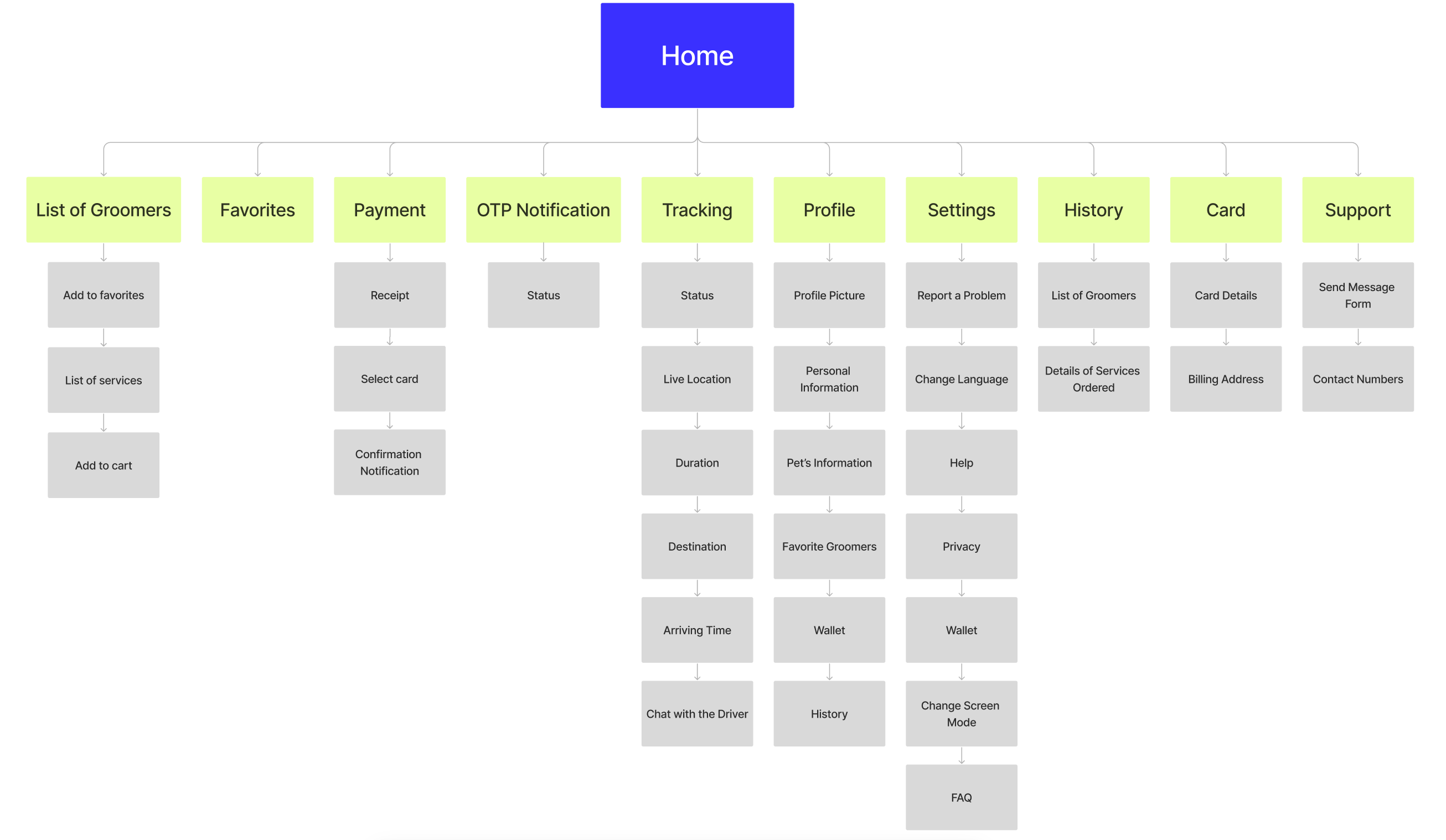
I chose the guided booking approach because the research was clear that users' primary anxiety wasn't about which groomer to pick, it was about feeling safe handing their pet off at all. A browsing-heavy marketplace model would have amplified comparison paralysis without addressing that core concern. Guiding the user through trust signals first made the selection feel like a confirmation, not a gamble.

Because trust is central to Groowf, several interaction patterns were explored for visibility and reassurance.
Options ranged from profile-heavy verification to embedded trust indicators within booking steps. Transport tracking concepts also evolved from map-dominant layouts to simplified progress-based updates to reduce information overload.
Decision: Integrate trust cues directly into the flow and prioritize clarity over feature density.

The decision to defer advanced filtering wasn't just about scope, it was about avoiding the feature overload that the competitor analysis flagged as a key friction point. The MVP needed to prove that a trust-first, guided booking flow could work before adding complexity on top of it.
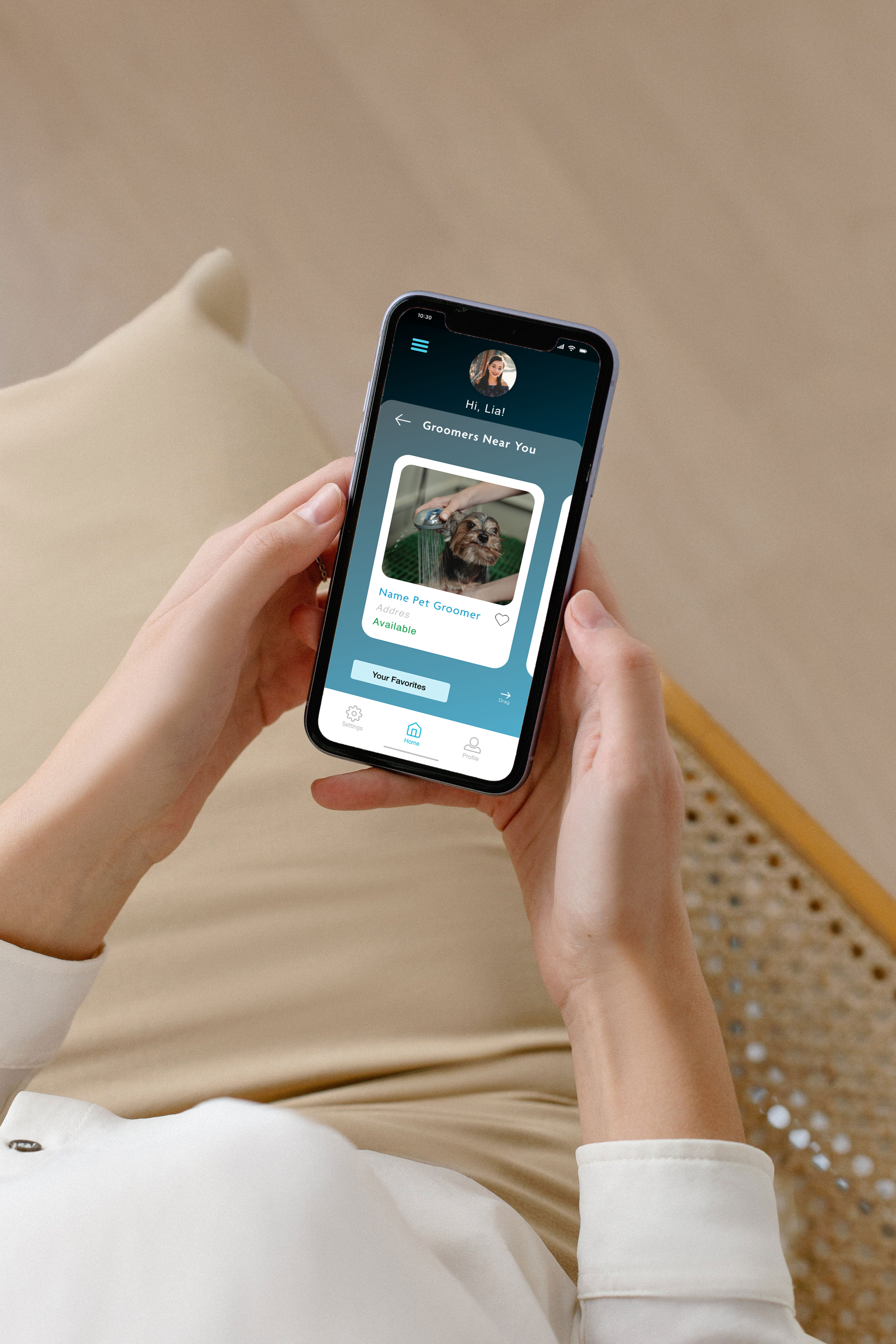
This project pushed me to think about trust as a design problem, not just a content problem. It's not enough to say a service is safe, the interface itself has to communicate safety through what it shows, when it shows it, and what it asks the user to do next. The biggest decision was reframing transportation from a logistics feature into a core UX layer, and that single shift changed the entire information hierarchy of the app. What I'd validate next with real users is whether the guided flow feels reassuring or restrictive, that tension is the most interesting design question still open.

Groowf is moving toward an MVP, with a focus on validating the booking and transport flows through iterative prototyping and user testing. Key priorities include refining trust signals, streamlining scheduling, and establishing scalable patterns for groomer onboarding. Early feedback will guide adjustments to interaction clarity, information hierarchy, and overall efficiency as the product evolves.